
Maximizing Construction ROI with IEEE 802.3bt Power over Ethernet
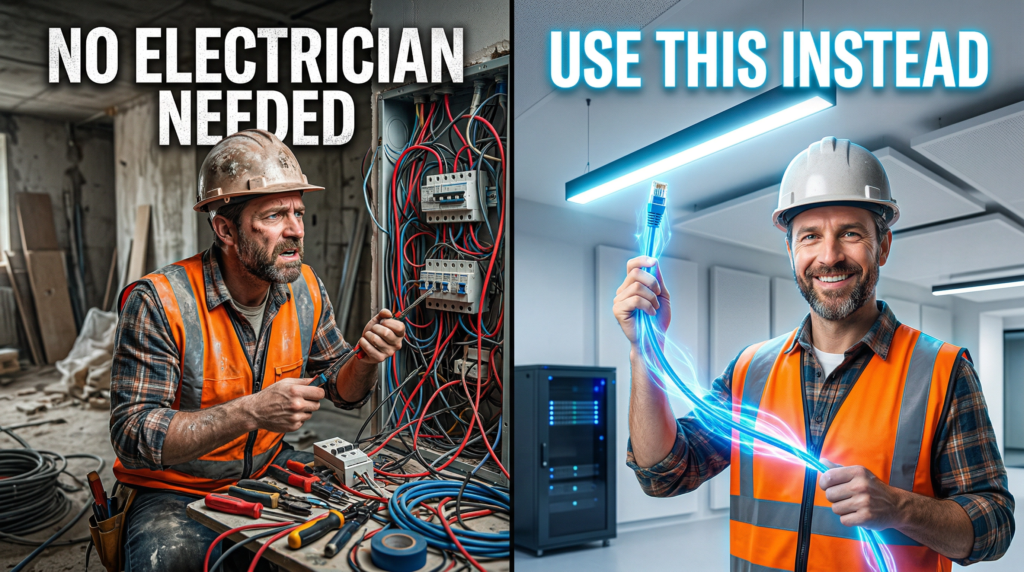
Why are we still wiring our commercial buildings like it’s 1985?
I have spent thirty years in San Diego watching this city grow, and I have seen my fair share of construction sites that turned into budget nightmares. Most of those headaches come down to the same basic problem. It is the high cost of specialized labor and the slow pace of getting everything wired up correctly.
When you are building a new office in Lemon Grove or upgrading a warehouse in Vista, every hour a licensed electrician spends pulling thick copper wire is a hit to your pocket. I have seen projects stall for weeks because the electrical subs were backed up or material costs spiked. We need to be more efficient with our resources. As someone who advocates for connected smart buildings and has spent decades in professional circles, I believe we should be looking at smarter ways to power our businesses.
Let’s be real about this. Most people think of an internet cable as something that just carries data to a computer. That changed for good with the IEEE 802.3bt standard. We used to be limited in the amount of power we could deliver over a network cable, but now we can send up to 71.3 watts across all four pairs of a Category 6A cable. That is enough juice to power LED lighting, high-end security cameras, and even the IoT sensors that make a building “smart”.
The Real Math of Construction ROI
This isn’t some fancy tech upgrade for the sake of looking cool. It is about the math of your return on investment. In California, hiring a licensed electrician for high-voltage work is expensive, and their schedules are usually a mess.
Structured cabling is a different story. You can have a professional cabling team install your lights and sensors much faster than a traditional electrical crew. Because Power over Ethernet (PoE) is low voltage, it does not require a licensed electrician for installation in many cases. You are essentially bypassing the bottleneck that slows most commercial builds while cutting your labor costs.
I remember talking to some of my colleagues about a development project, and the conversation kept coming back to “soft costs.” Those are the things that eat your margin while you wait for inspections and specialized trades. By using 802.3bt PoE, you move those tasks to the data team. They can pull the Cat 6A, plug in the smart lighting, and have the system running before the drywall is even finished. It significantly speeds up your construction timeline.
Why Category 6A Is Not Negotiable
Where I grew up, you learned to do a job right the first time so you didn’t have to pay for it twice. If you are going to use the 802.3bt standard, you cannot cut corners on the cable. You need Category 6A.
Pushing 71 watts creates heat. Older cables like Cat 5e or even standard Cat 6 are not built to handle that kind of thermal load when they are bundled together. Cat 6A has better insulation and thicker copper, which helps dissipate that heat. If you try to save a few pennies by using cheaper wire, you might find your network performance dropping as the cables warm up. I’d like to think we are smarter than that.
Think of it as the foundation of your building. You would not build a house on sand, and you should not build a smart office on old-fashioned wiring. Using premium Cat 6A ensures that your building can handle whatever new tech comes out in five years.
A Reflective Look at Energy Efficiency
From an energy efficiency perspective, this shift is a win. Traditional lighting systems waste a lot of energy by converting AC to DC at every bulb. When you use PoE, that conversion happens at a central, efficient power supply in your server room. It is a cleaner way to manage your energy footprint.
At the end of the day, you want a building that works for you instead of a building that you are constantly working on. Bypassing the traditional electrical hurdles and moving toward a networked power system is the most logical step for any business owner in San Diego County. It simplifies your maintenance and gives you more data on how your space is actually being used.
Take a step back for a second and look at your next project. Are you going to stick with the old way because that is how it has always been done? Or are you going to use the tools that are right in front of you to save time and money? The competition is already moving to smarter cabling. Don’t let your brand get left behind because you were afraid of a little change.
Leave A Comment